Note 05 · The footprint
Reading Generator Sets as One System
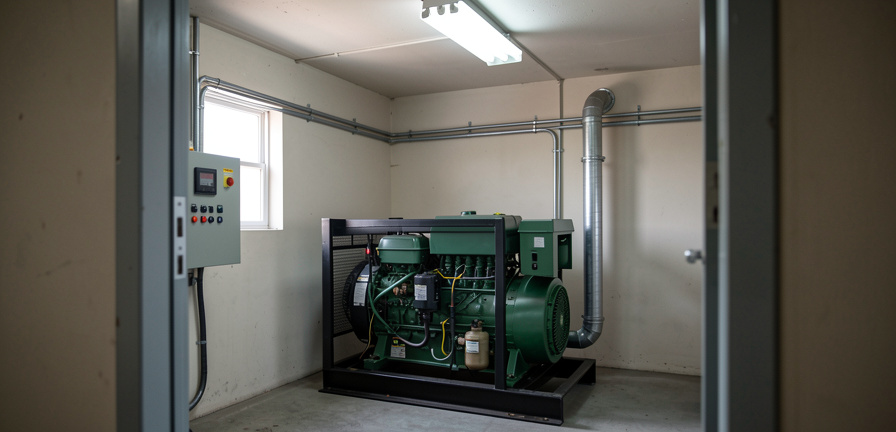
A generator set is a system, not a brand name. The load profile, the transfer equipment, the fuel supply, the exhaust path, and the maintenance record all decide whether a site keeps running. Reading those parts together is the only way to know what a machine can actually do.
What a generator set has to carry
Every generator set starts with a load profile. That profile lists what must run, in what order, and for how long. Essential loads come first: safety systems, controls, communications, and any process that cannot stop without damage. Rated mode comes later, and it describes what the machine can hold continuously under stated conditions.
A clear sheet on load, starting, transfer, and safety limits helps a technical exchange begin in the right place. That is the approach behind a structured reading of generator data, where load profiles, safety checks, and operating logs connect to each other. The point is not to collect names. The point is to see how the parts behave when the utility source fails.
Starting is where many sites get surprised. Motors draw several times their running current at startup. If several motors start at once, the generator sees a step load that can pull voltage and frequency down. A load profile that lists starting order, starting current, and acceptable voltage dip is more useful than a single total in kilowatts.
How do transfer and protection fit together?
Transfer equipment decides when the generator takes over and when it gives the load back. An automatic transfer switch (ATS) senses the utility source, starts the generator, and moves the load after the generator reaches acceptable voltage and frequency. The settings on that switch, the delay before transfer, the delay before retransfer, and the cool-down period, shape how the site experiences an outage.
Protection sits around the transfer path. Air circuit breakers (ACB) and molded case breakers isolate faults. A controller manages start signals, cooldown, and shutdowns. Voltage and frequency are read at the generator terminals, but the load sees them at the end of the cable run. Cable size, distance, and transformer configuration all affect what the load receives.
A common mistake is to treat the transfer switch, the breaker, and the controller as separate purchases. They are one chain. If the ATS is set to transfer too early, the generator may see a load it cannot hold. If the breaker is sized only for the generator and not for the cable, the cable becomes the weak point. If the controller has no input for fuel level or coolant temperature, the first sign of trouble is a shutdown.
What exhaust, siting, and fuel questions decide
Exhaust and siting are not afterthoughts. Exhaust gas contains carbon monoxide (CO), nitrogen oxides, and particulate matter. In residential and small commercial settings, exhaust direction, stack height, and distance from windows and air intakes decide whether the installation is safe. A generator that runs well but vents into a occupied space is a hazard, not a backup.
Siting also covers noise, vibration, and service access. A unit placed against a wall with no room for a technician will be maintained less often. A unit placed where snow or water can reach the air intake will fail in the conditions when it is needed most.
Fuel questions follow the same logic. Diesel, natural gas, and propane each bring different storage, delivery, and maintenance needs. Fuel quality matters: water, sediment, and microbial growth in diesel can clog filters and stop a machine that started fine last month. Runtime at full load, not just tank size, tells a site how long it can ride through an outage. Fuel polishing, filter changes, and tank inspections belong in the operating log, not in a folder that no one opens.
What does load testing actually prove?
Load testing proves that the generator can carry its expected load under controlled conditions. A test at no load or light load confirms that the machine starts and runs. It does not confirm that the cooling system, the fuel system, and the exhaust system can handle rated output for an extended period.
A useful test program includes several levels. A monthly start and run at light load checks the starting system, the battery, and the controller. A periodic test at a significant fraction of rated load checks temperature, fuel consumption, and voltage stability. A full-load test, run long enough for temperatures to stabilize, checks the whole chain: engine, alternator, cooling, exhaust, and transfer.
Records matter as much as the test. Date, ambient conditions, load level, duration, fuel consumed, coolant temperature, oil pressure, voltage, frequency, and any alarms. A log with those fields turns a test into evidence. Without them, a test is only a memory.
How do maintenance and autonomy connect?
Autonomy means the site can run without the utility for a defined period, and that the claim can be checked. Maintenance is what keeps that claim true. Oil and filter changes, coolant checks, battery voltage and specific gravity, belt tension, and fuel system inspections are the routine items. Less routine items include alternator insulation checks, breaker testing, and calibration of the controller and sensors.
A generator that is never exercised can fail at the moment of transfer. Batteries lose charge, fuel ages, seals dry, and insects build nests in air paths. A schedule that exercises the machine under load, even briefly, keeps those failure modes visible.
Autonomy also depends on the load. A site that adds a new server room or a new chiller changes its own load profile. The generator that was adequate two years ago may now be marginal. Reviewing the load profile after any significant change is part of keeping the system honest.
What compliance points are usually missed?
Compliance covers emissions, electrical safety, and fuel storage. Emissions rules vary by location, engine size, and application. Some jurisdictions require permits for stationary engines above a certain rating. Others set limits on exhaust opacity or hours of operation for testing.
Electrical compliance covers grounding, bonding, and protection coordination. A generator that is not properly grounded can create shock hazards and can interfere with the utility source. Protection coordination ensures that the breaker closest to a fault trips first, so a small problem does not shut down the whole site.
Fuel storage compliance covers tank construction, secondary containment, leak detection, and labeling. A tank that meets code at installation can fall out of compliance if vents are blocked, labels fade, or containment drains are left open.
Reading the system, not the label
A generator set is judged by what it does under load, not by what is printed on the enclosure. The useful questions are concrete. What starts first? What is the largest step load? How long can the site run at that load? Where does the exhaust go? Who checks the fuel? When was the last full-load test, and what did the log say?
Those questions do not require a brand preference. They require a reading of voltage, current, transfer logic, fuel, exhaust, and maintenance as one system. A site that answers them has a backup power plan. A site that does not has a machine and a hope.