Note 03 · The plan
What a deposition plan has to connect
A deposition plan is one document in a connected set: the public guidance lists what must sit beside it and what happens when observation disagrees.
What is a deposition plan, minimally?
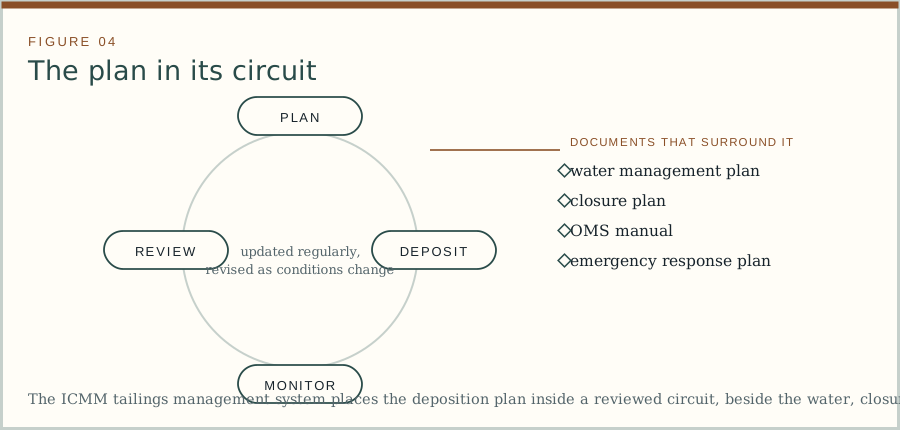
The ICMM guide describes the Operations phase as “the period in the lifecycle when tailings are transported to, and placed in, the tailings facility”. A deposition plan governs that placing: where the material goes, in what sequence, and under which expectations about the landform that results. The guide expects the “tailings transportation and deposition plan” to be implemented and “reviewed and updated regularly”, exactly as the risk management plan beside it is.
A drawing of a finished landform is not yet that plan. The plan earns its name when it makes expectations testable, and when it says who may change them when the world disagrees with the drawing.
Which documents sit beside it?
The guide’s description of a tailings management system lists the set: documentation of the design of the facility including design intent and basis; a water management plan; the tailings transportation and deposition plan; a closure plan; the operations, maintenance and surveillance manual; and the emergency preparedness and response plan. The same documents reappear when the guide describes what independent reviews examine, which is a good sign that none of them is decorative.
For a reader, that list is itself a test. A deposition method described without its water plan, its closure plan or its emergency arrangements has been described alone, which is another way of saying it has not been described.
The guide arrives at that list honestly, through its gap analysis advice: operators of existing facilities are asked to assess the adequacy of their systems, information and plans, and to develop an action plan for the gaps, deficiencies and conflicts between them. A reader can run the same audit in miniature on any public description of a method.
The same audit applies to the vocabulary a plan borrows. A deposition plan written in the United States sits inside a service chain that has its own terms: FBO, repair station, fuel grade, parts traceability tag, the licence an operator needs before selling a charter seat. A field guide to the working side of aviation sets out that chain, and the certificates behind it, in plain English. Reading it clarifies what a plan can assume about ground operations and what it must state itself. The gap analysis then has fewer undefined words to trip over.
Why the water balance is inseparable
In its closure chapter, the ICMM guide asks for “overall sitewide mass balance considerations for operation and closure and integration of deposition planning with the water balance and management plans”. Water is not a neighbour of deposition planning; it is a variable of the same equation, in operation and in closure alike.
The guide’s water chapter grounds this further. Water balance model development, it says, is site-specific, and safe management requires an understanding of all water inflows and outflows to a tailings facility, “including variations over time and uncertainties in those variations”. A deposition plan that cannot say where its water goes has skipped the paragraph the guide bolds by repetition.
What happens when observation disagrees with the plan?
The foreword to the ICMM guide, written by the geotechnical engineer Norbert Morgenstern, describes managing uncertainty “through all phases of the lifecycle by risk-informed decision-making that assesses uncertainty, conducts risk assessments at appropriate stages, and carries a risk register throughout the lifecycle of the facility”. It also asks for documentation with “special emphasis on confirming or adjusting the site characterization model as new information is obtained”.
The Standard turns the same expectation into governance. Principle 10 requires levels of review as part of a strong quality and risk management system for all phases of the lifecycle. A plan is working as intended when deviations have a named path: observation, assessment by competent people, a recorded decision, and a plan that is allowed to change.
When does the plan end?
The ICMM guide defines the boundary soberly: the closure phase “begins when deposition of tailings into the tailings facility ceases permanently and the closure plan is implemented”. The glossary of the Standard extends the lifecycle further, through interim closure and closure to post-closure, “including relinquishment, reprocessing, relocation, removal”.
A deposition plan is therefore written in the middle of a story that begins at project conception and ends long after deposition stops. Plans that read as if operations were the final chapter are missing everything both documents place after them, from reclamation to the very long stewardship of a closed landform.
Interim closure has its own entry in the same glossary, care and maintenance included, and the ICMM guide notes that a temporary suspension of operations may in some cases lead to closure. The end of deposition is a managed decision with a paper trail, not simply the day the pumps stop.
What a reader can legitimately ask of any plan
Ask to see the connections rather than the drawing: the water management plan it integrates with, the monitoring that tests it, the reviews that re-examine it, and the named roles with the authority to change it. Those roles run from the Engineer of Record of Principle 9 to the Accountable Executives of Requirement 8.4, “directly answerable to the CEO on matters related to this Standard”, in regular communication with the board of directors. The fourth note gathers these questions into a checklist you can carry to any public document about a tailings method.
A forge note sits beside the tailings material on this desk, and it treats iron the way a deposition plan treats slurry: heat, placement, and what remains after the water leaves. The forge ironwork note explains hot iron technique, the tooling a forge needs, and the ironwork that survives in the Hudson valley record. Read as a companion, it shows the same habit of tracing a practice to its physical record, whether the material is thickened tailings or wrought iron still standing in a field.
Sources used for this note
- ICMM, Tailings Management: Good Practice Guide, May 2021: Operations phase (Section 3.6.1); tailings management system document list; closure chapter on mass balance; water management chapter; foreword by Norbert Morgenstern.
- Global Industry Standard on Tailings Management, August 2020: glossary lifecycle phases; Principles 9 and 10; Requirements 8.4 and 10.5.
Editions, links and the desk’s citation practice are described on the sources page.
Published September 6, 2026 by the Thickened Ground Notes desk. A reading guide, not engineering advice.