Note 04 · The review
Questions for reviewing a tailings method
A checklist drawn from the Standard itself: which decision, which named roles, which classification, which knowledge, which monitoring, and what is public.
Which decision is this document supporting?
Reviews go wrong when they judge a document for a decision it was never asked to support. Principle 4 of the Standard asks operators to “develop plans and design criteria for the tailings facility to minimise risk for all phases of its lifecycle, including closure and post closure”. Before evaluating quality, name the decision in front of you: adopting a design, changing a discharge sequence, suspending operations, or beginning closure.
Once the decision is named, the evidence it needs becomes visible, and so do the documents that owe you an answer. A review that skips this step grades prose instead of practice.
Who is accountable, in which named role?
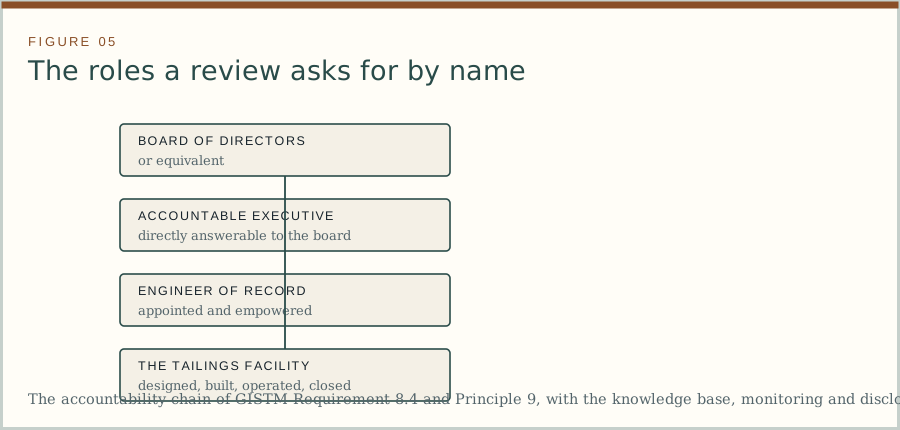
The Standard is unusually concrete about names. Requirement 8.4 asks operators to “appoint one or more Accountable Executives who is/are directly answerable to the CEO on matters related to this Standard”, keeps them in scheduled communication with the Engineer of Record and regular communication with the board, and has the board document how it holds them to account. Requirement 4.3 gives the Accountable Executive the decision to adopt a design for the current consequence classification. Principle 9 requires appointing and empowering an Engineer of Record, and Requirement 9.1 details that engagement for facilities of higher classification, down to the senior engineer who must be nominated to represent the firm.
A method review that cannot name the accountable roles is reviewing paper, not a facility. The question costs nothing to ask and embarrasses exactly the documents that deserve it.
What consequence classification applies?
Annex 2 of the Standard grades dam failure consequences from Low to Extreme by potential population at risk and potential loss of life, summarised in the table below. The classification is not trivia. Requirement 4.3 ties the adopted design to it, and Requirement 10.5 sets the frequency of independent Dam Safety Reviews by class: at least every five years for facilities classified Very High or Extreme, and at least every ten years for all others.
Requirement 4.2 also has the classification itself revisited at the Dam Safety Review and at least every five years, or sooner if the social, environmental or local economic context changes materially, wherever the adopted design must stay upgradeable, and it applies the same review to existing facilities. A document that quotes a method without its classification has quoted a body with no weight class.
What knowledge stands behind the numbers?
Principles 2 and 3 require an interdisciplinary knowledge base maintained across the lifecycle, and used in full: “social, environmental, local economic and technical” elements together inform decisions. When a document quotes a number, whether a moisture content, a slope or a return period, the review question is which part of that base produced it, when, and how it is kept current.
The maintenance matters as much as the breadth. The Standard asks for the base to be developed and maintained, which implies a living record rather than a study bound to the year the facility was designed, and a review should ask what has entered it since.
What monitoring would reveal a failing assumption?
Principle 7 requires operators to “design, implement and operate monitoring systems to manage risk at all phases of the facility lifecycle, including closure”. A method description without a monitoring story is a forecast with no instrument attached. Ask what is measured, at what frequency, against which trigger values, who reads the readings first, and what those readings are allowed to interrupt.
A greenhouse gas footprint is not a single measurement but an arithmetic result. Activity data, such as litres of fuel or kilowatt hours of electricity, are multiplied by emission factors, and the products are summed into one carbon dioxide equivalent figure. The boundary chosen for that sum matters: a household and an organisation draw the line in different places, so the same activity can land on one side or the other. A calculator applies its own boundary and leaves some sources outside it. The greenhouse gas footprint note sets out this combination and what a calculator omits.
What is disclosed to the public?
Principle 15 asks operators to “publicly disclose and provide access to information about the tailings facility to support public accountability”, and the preamble frames disclosure as a requirement of the Standard rather than a courtesy. For a reader, disclosure separates reassurance from evidence. A claim that will never face a public record deserves more scepticism, not more trust, and a facility that discloses its reviews earns the patience its method description asks for.
What can no checklist settle?
The preamble of the Standard says it “provides a framework for safe tailings facility management while affording Operators flexibility”, and that conformance “does not displace the requirements of any specific national, state or local governmental statutes, laws, regulations, ordinances, or other government directives”. No general document, this checklist included, can approve a location, set a consequence classification or replace independent review by qualified people holding current data.
What a checklist can do is make the right questions harder to skip. If a public description of a tailings method answers the six above by name and number, it has treated its readers as adults, which is itself a signal about how it was written.
A deposition plan sets out where material goes and how it behaves once placed. The same logic of storage and slow release appears in buildings, where heat is managed rather than generated on demand. A companion reading note on this desk, the passive systems note, describes three elements of a low-energy building: the thermal barrier in an external wall, ground heat storage, and earth tubes. Each one holds or moves energy across a boundary, much as a deposit holds water and releases it over time. The note is written in plain English and stays descriptive, with no advice and no product to sell.
| Consequence classification | Potential population at risk | Potential loss of life |
|---|---|---|
| Low | None | None expected |
| Significant | 1 to 10 | Unspecified |
| High | 10 to 100 | Possible (1 to 10) |
| Very High | 100 to 1,000 | Likely (10 to 100) |
| Extreme | More than 1,000 | Many (more than 100) |
Sources used for this note
- Global Industry Standard on Tailings Management, August 2020: preamble; Principle 4; Principle 7; Principle 9; Principle 15; Requirements 4.3, 8.4, 9.1 and 10.5; Annex 2, Table 1.
- ICMM, Tailings Management: Good Practice Guide, May 2021: foreword and governance chapters, read for context around each question.
Editions, links and the desk’s citation practice are described on the sources page.
Published September 6, 2026 by the Thickened Ground Notes desk. A reading guide, not engineering advice.