Note 05 · The footprint
Gensets and Industrial Power: Reading the System
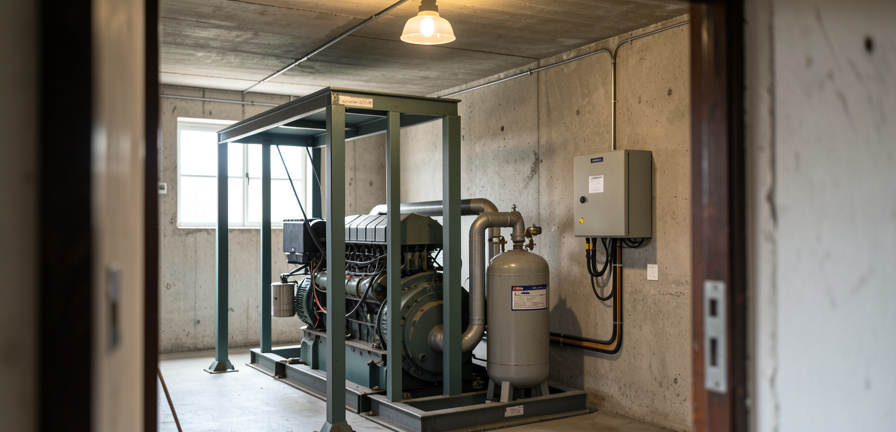
A generator set is not a box with a brand on it. It is a chain of decisions about load, starting, transfer, fuel, exhaust and maintenance, and each link constrains the others. Reading that chain before a technical exchange is what keeps the conversation on the right ground.
Start with the load, not the machine
The load profile comes first. A standby set sized for a whole facility behaves differently from one that carries only essential circuits, and the difference shows up in starting current, voltage dip and fuel burn. Essential load is the part that must stay live: safety lighting, controls, communications, pumps, refrigeration, servers. Rated mode is what the machine can hold continuously under stated conditions. Between those two lies the operating range where most real questions live.
A clear sheet on load, starting, source transfer and safety limits is what makes a technical exchange begin in the right place. That is the logic behind a structured reference for generator rooms, where the operating space is read through data rather than through a logbook. Sections run from a load schedule to safety checks and operating records, which is the order in which a review usually needs them.
Sizing shortcuts fail in predictable ways. A set chosen by building area rather than by measured load will either run lightly loaded, which harms combustion and maintenance intervals, or trip on motor starting. Measuring the load, including the largest motor and its starting method, is the only honest starting point.
What does source transfer actually require?
Transfer is a sequence, not a component. The set must start, reach voltage and frequency, accept load, and only then release the normal supply. The transfer device, whether an automatic transfer switch or a breaker-based arrangement, enforces that order. Voltage, ATS, ACB, controllers, engines and enclosures have to be read as one system, not by brand name alone.
Three questions shape the design. How long may the load be without power? That sets the acceptable transfer time. What happens if the normal source returns while the set is running? That sets the retransfer and cooldown logic. What prevents both sources from being connected at once? That sets the interlock, mechanical or electrical, and it is not optional.
Return current and source separation belong here too. A set that is not properly separated from the utility can backfeed a line that someone believes is dead. The interlock and the earthing arrangement are the parts of the drawing that deserve the closest reading.
Fuel, runtime and the autonomy question
Runtime is a calculation, not a claim. Fuel volume, usable draw, consumption at the expected load and the reserve kept for testing and cooldown all enter it. A tank that looks generous at half load may be marginal at rated load, and marginal again if the load grows after commissioning.
Fuel quality matters as much as quantity. Storage duration, water and sediment, filtration and the condition of the day tank all affect whether the set starts on the first attempt after months of standby. Fuel, runtime, load testing, starting and maintenance form one autonomous system that can be monitored and verified, which is the framing that keeps a maintenance plan honest.
For small infrastructure, a shop, a workshop or an office, the practical target is usually a defined number of hours at a defined load, with a stated refuelling plan. Writing that number down turns a vague promise into something that can be checked.
Emissions, siting and the questions that follow
Exhaust is a siting problem before it is a compliance problem. Where the outlet points, how far it sits from windows, doors and air intakes, and how the plume behaves in still air all decide whether the installation is workable. Carbon monoxide, return current, source separation and shutdown points are core topics for prevention and compliance.
Indoor installations raise the stakes. Exhaust, machine position, fuel and the practical questions that appear when backup power is used inside a residence or a small building are not the same as those for an outdoor canopy. Ventilation, acoustic treatment and fire separation all compete for the same room.
Noise is part of siting as well. A set that meets its electrical duty but sits against a neighbouring wall will generate complaints that no datasheet anticipated. Position, enclosure and exhaust routing are the levers.
How should testing and maintenance be organised?
Testing should reproduce the conditions the set will face. A monthly no-load start proves little beyond the battery and the starter. A periodic load test at a meaningful fraction of rated power proves the fuel system, cooling, governor and transfer sequence together.
Records make the difference over years. Starting attempts, running hours, load applied, fuel added, faults and corrective actions build a history that shows degradation before it becomes a failure. That history is also what a reviewer will ask for first.
Maintenance intervals follow the manufacturer, but the surrounding system sets the real risk. Batteries, coolant, belts, filters, heaters and the transfer device all age whether or not the set runs. A standby machine spends most of its life not running, and that is precisely when components quietly fail.
What a review should ask before approving a design
A short list covers most cases. What is the measured essential load, and what is the largest starting current? What transfer time is acceptable, and how is the interlock proven? How many hours of autonomy are required at what load? Where does the exhaust discharge, and what is the separation from openings? What test schedule will be followed, and who records the results?
If those answers exist in writing, the technical exchange moves quickly. If they do not, the discussion drifts toward brand names and catalogue pages, which resolve nothing. The machine is the last item in the chain, not the first.
Reading the installation as one system
A generator installation is legible when its parts are described together: load, starting, transfer, fuel, exhaust, testing and records. Each one can be checked, measured and written down. That is what makes a review possible and what makes an operating space readable through data rather than through memory.
For anyone preparing a specification, a purchase or a safety review, the useful habit is to ask for the chain rather than the product. The chain shows where the risk sits, and it shows which questions still have no answer.